

Overview
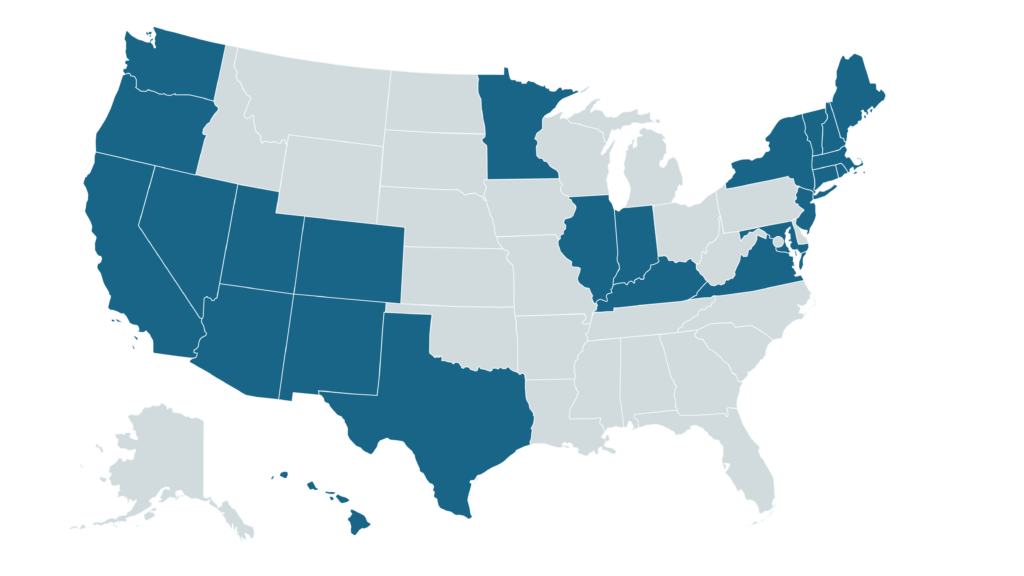
Bolstered by new federal funding and state-wide commitments to eliminate greenhouse gas (GHG) emissions, many states are increasing their focus in 2023 on reducing carbon pollution from the built environment. So far this year, at least 147 bills have been introduced across 24 states to reduce emissions and increase energy efficiency in buildings.
Why Decarbonizing Buildings Matter
Currently, commercial and residential buildings account for 13% of GHG emissions and 28% of energy consumption in the United States. Electrifying buildings and making energy efficiency upgrades can reduce overall energy demand in the U.S., while providing a range of benefits such as cost savings and job creation, carbon pollution reduction, and improved indoor air quality. That’s why many states that are leading on climate action view buildings as the next major emission source to address in the fight against climate change.
The 2023 State of Play – Which States are Moving Bills?
Of the 24 states that have introduced building decarbonization bills so far in 2023, at least eleven have passed bills in one legislative chamber or more, and at two three – Colorado and Utah – have enacted legislation.
Bills Signed into Law
Colorado recently enacted H.B.1134, which will require home warranty companies to provide homeowners the option to replace gas-powered appliances with electric alternatives. The other state that has enacted building decarbonization legislation in 2023 is Utah (H.B.217), which has authorized grants to be awarded to schools for programs to reduce energy and water use.
Leveraging Federal Investments
There is a notable increase in states introducing legislation that would address building decarbonization through new federal funding from the Inflation Reduction Act (IRA). Minnesota’s H.F.2771 would provide rebates for the adoption of residential heat pumps to accompany federal rebates from the IRA. Vermont’s S.5 would establish a “Clean Heat Standard,” a fossil fuel trading mechanism designed to incentivize Vermonters to transition to heating and cooling systems that reduce carbon emissions. Vermont’s bill stipulates that the state should maximize the use of federal funds, such as those from the IRA, to deliver clean heat measures.
Comprehensive Standards
More states are also aiming to establish statewide standards to facilitate building decarbonization and energy efficiency. On May 2, legislators in New York approved a state budget (A.3006) that includes the first-in-the-nation statewide ban on fossil fuels in new buildings (originally introduced as the standalone policy, the “All-Electric Building Act”). Maryland also recently passed legislation (S.B.144/H.B.169) that would mandate a statewide plan be developed to provide energy efficiency retrofits to all low-income households by 2031, among other energy efficiency and conservation measures.
Stay Informed on 2023 Building Decarbonization Policy
Stay up to date on the status and trends of building decarbonization legislation around the country this year with NEC’s Bill Tracking Map.
Support the Network
Your generosity helps create opportunities for state legislators to meet, collaborate, and improve lives in their states.


Subscribe to the National Environmental Caucus Newsletter
Stay up to date on upcoming events, opportunities to expand your network, and the latest environmental policy trends from across the U.S.