
Overview
On December 12, Michigan enrolled H.B.5600 establishing a Tribal Legislative Liaison Office. This first-of-its-kind law creates a point of contact between Tribes and the legislature and will inform the legislature of Tribal issues. The Tribal Legislative Liaison Office is charged with establishing and maintaining a government-to-government relationship between the 12 federally recognized Tribes in Michigan and the legislature. The Office will also consult with the legislature during the development of legislation that affects federally recognized Tribes in Michigan such as land, water, wildlife, and economic development issues.
In addition, the Tribal legislative liaison office will also provide at least one hour of training annually to legislators and their staffers on the history and current state of the 12 federally recognized Tribes in the state, as well as how to work with the liaison.
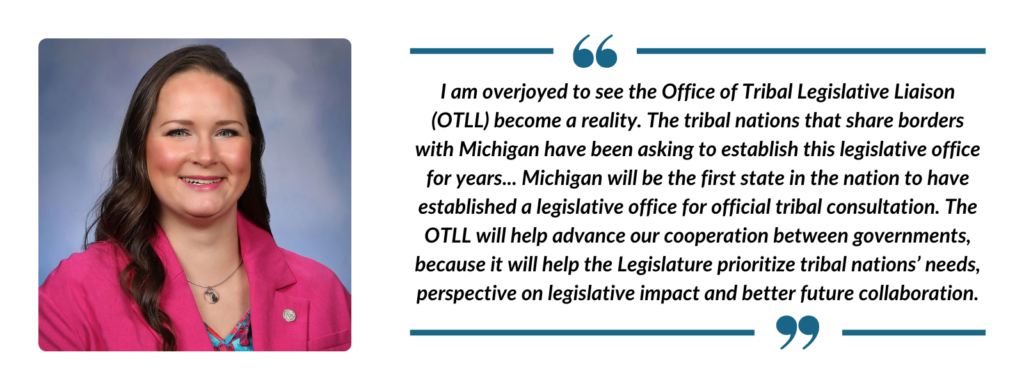
Michigan State Representative Carrie Rheingans
Other State Action
This session, 10 states enacted at least 13 bills advancing state/Tribal relationships across consultation, co-governance, and other restored relationships. Notable examples include:
- California A.B.1284 authorizes the Secretary of the Natural Resources Agency or a delegate to begin government-to-government negotiations on co-governance and co-management agreements with the Tribe with negotiations to begin within 90 days of a Tribe’s request.
- Maine LD 2007 makes substantial changes to the Maine Indian Claims Settlement Implementing Act to help Wabanaki Nations in Maine exercise their inherent right to self-govern, as all other federally recognized Tribes in the United States are able to do under Federal Indian Law.
- Virginia H.B.1157 creates clear guidelines and rules for consultation with Tribal Nations on environmental, cultural, and marine issues.
In addition, at least 20 states explored ways to better recognize their responsibilities to and opportunities with Tribal Nations this session.
- Why it matters: Tribal Nations are sovereign nations that share many interests and responsibilities with the states they border. States have treaty obligations to Tribes under the U.S. Constitution and other federal law, but also have tremendous opportunities to mutually benefit from sharing resources, knowledge, and governance.
- Additional capacity like a Tribal legislative liaison office enhances the legislature’s ability to conduct good government-to-government partnership, which, in turn, benefits all citizens, Tribal, and non-Tribal alike.
Additional Resources
Learn more about Tribes’ role in the legislative process by exploring the following:
- NAP/NEC Learning Series – Policy Essentials for Strong State/Tribal Relations
- Hear Michigan lawmaker Sen. Jeff Irwin discuss the story behind HB 5600 at minutes 16:00 and 31:45
- State and Tribal Relationships Fact Sheet
- Indian Country 101 Training (Section B: “The Tribal-State Relationship”)
- Partnering With Native Nations In a Good Way Guide – Native Governance Center
Support the Network
Your generosity helps create opportunities for state legislators to meet, collaborate, and improve lives in their states.


Subscribe to the National Environmental Caucus Newsletter
Stay up to date on upcoming events, opportunities to expand your network, and the latest environmental policy trends from across the U.S.